

In theory, every organization wants to be compliant.
In practice, many fail — not because they lack policies, but because they lack digital structure.
Compliance is not a document.
It is a system of connected proofs.
Without a digital foundation linking people, processes, and records, even the best compliance strategy collapses under audit pressure.
⚠️ The Silent Reason Compliance Fails
Compliance rarely fails loudly at first.
It weakens slowly — through scattered folders, manual registers, and email-based approvals.
Here’s what typically goes wrong:
| Issue | Impact | Real Example |
|---|---|---|
| Fragmented data | Inconsistent reporting | Quality data stored separately from audit checklists |
| Paper-based records | Delayed verification | Missing signatures or faded hard copies |
| Email approvals | No traceability | “Who approved this?” → No clear answer |
| No version control | Wrong document submitted | Outdated SOP uploaded during ISO audit |
| Manual tracking | No workflow proof | Auditors can’t verify real-time progress |
These gaps grow quietly.
Then an audit exposes them.
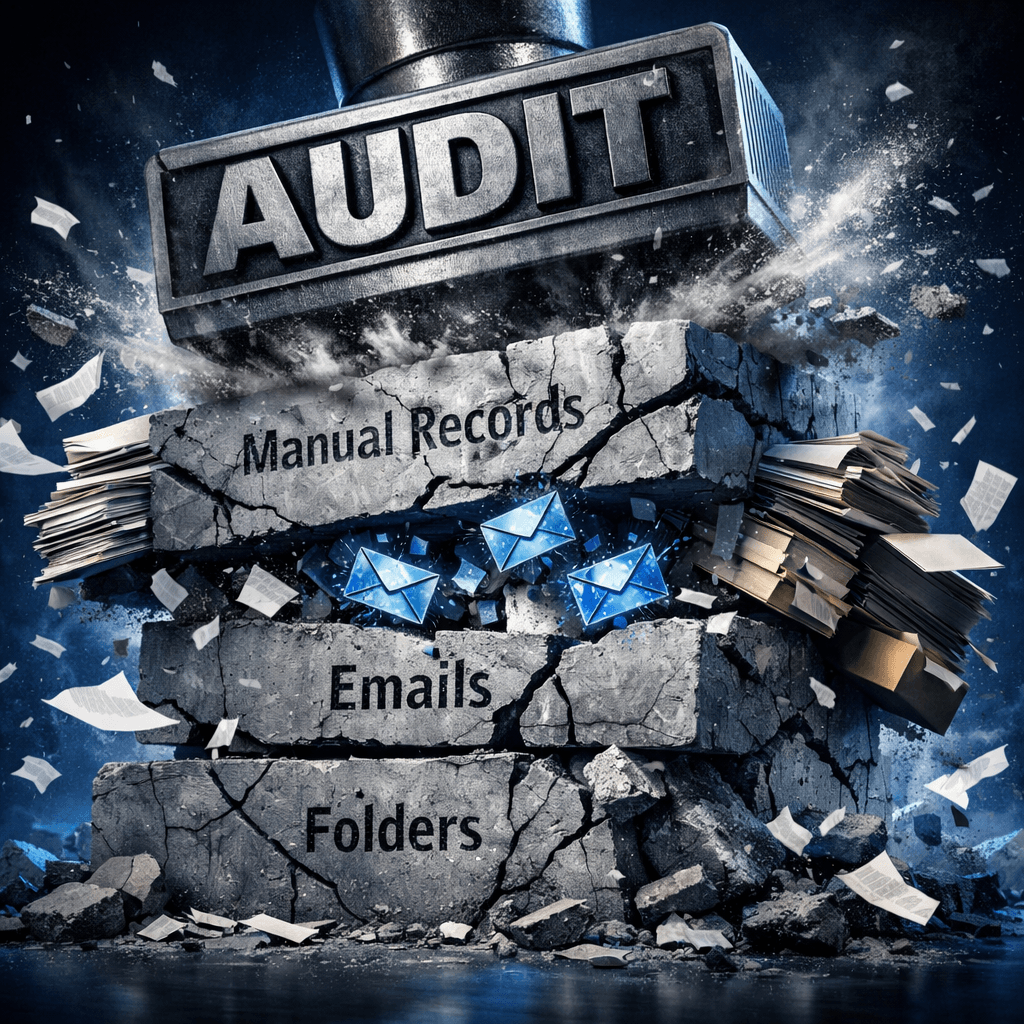
A cracked compliance structure labeled “manual records,” “emails,” and “folders” breaking under audit pressure.
🧱 The Digital Foundation Compliance Needs
True compliance requires a system that:
- Captures every action
- Links documents to workflows
- Preserves version history
- Generates proof automatically
This is where DBOMS transforms compliance from reactive to proactive.
DBOMS is not just storage.
It is a structured compliance engine.
🗂️ 1. A Single Source of Truth
DBOMS eliminates scattered drives and disconnected files.
Every document:
- Lives in one structured repository
- Is indexed and searchable
- Maintains verified version control
- Teams no longer debate which file is final.
DBOMS ensures one approved version is active at all times.
⚙️ 2. Custom Workflows That Match Regulations
Compliance frameworks vary across industries:
- ISO for manufacturing
- GMP for pharma
- DGCA for aviation
- FAA for aircraft maintenance
DBOMS allows organizations to define their own structured workflow:
Draft → Queried → Reviewed → Approved → Archived
Each stage is timestamped and role-controlled.
This aligns operations directly with regulatory requirements.
Compliance is not enforced manually.
It is embedded into the workflow itself.
🧾 3. Built-In Approvals with Digital Trace
Every approval inside DBOMS is logged automatically:
- Approver identity
- Date & time
- Comments
- Status transitions
When auditors ask, “Who authorized this revision?”
The answer appears instantly.
This strengthens accountability while eliminating manual evidence collection.
🔒 4. Auto-Generated Audit Logs
Traditional systems compile audit evidence at the last minute.
DBOMS builds it continuously.
Every document carries:
- Version history
- Action history
- User access records
- Workflow movement
Audit logs are created in real time — not reconstructed later.
📊 Industry Impact
| Industry | Common Compliance Failure | DBOMS Solution |
|---|---|---|
| Aviation | Lost maintenance records | Cloud-based DGCA-aligned traceability |
| Pharma | Manual GMP approvals | Electronic signatures & version control |
| Manufacturing | Fragmented ISO documentation | Centralized SOP mapping |
| BPO / IT | Outdated policy records | Real-time access logs & approval tracking |
⚖️ DBOMS vs Traditional Compliance Systems
| Feature | Manual / Traditional | DBOMS |
|---|---|---|
| Centralized repository | ❌ | ✅ |
| Version control | Manual | Auto-versioned |
| Workflow tracking | Spreadsheet-based | Visual workflow engine |
| Audit trail generation | Post-event | Real-time |
| Regulatory alignment | Static documentation | Framework-linked processes |
🧠 Why Digital Foundations Matter
Think of compliance as a building.
Policies are the blueprint.
Training is the workforce.
But structured data is the foundation.
Without a strong digital base:
- Accountability weakens
- Traceability breaks
- Audit stress increases
DBOMS reinforces compliance through:
- Structured record management
- Role-based access control
- Real-time audit visibility
- Automated regulatory mapping
Compliance becomes a living system — not a checklist.
🚀 From Fragmented to Future-Ready
Compliance fails where manual systems dominate.
It succeeds where processes are digitally structured.
With DBOMS, every department works on a unified, secure, and traceable platform.
Workflows mirror compliance frameworks.
Evidence builds automatically.
No paper trails.
No missing approvals.
No audit panic.
Just clarity, control, and confidence — by design.