

Walk into most manufacturing offices a week before an audit and the scene is familiar.
Stacks of paper files.
Supervisors searching for last year’s calibration logs.
Quality teams trying to trace approval signatures.
When an audit arrives unexpectedly, the scramble begins.
But audit stress is not inevitable.
It is structural.
With DBOMS, audit-readiness becomes part of daily operations — not a last-minute emergency.
The Manufacturing Audit Reality
Manufacturing units operate on documentation:
- SOPs
- Inspection reports
- Maintenance logs
- Supplier certificates
- Training records
- Equipment calibration files
Many of these begin as paper forms or disconnected spreadsheets.
Here’s where the breakdown happens:
| Audit Challenge | Why It Happens | Impact |
|---|---|---|
| Missing records | Paper files not linked to digital logs | Audit delays & non-compliance remarks |
| Outdated SOPs | No structured version control | Incorrect processes followed on shop floor |
| Scattered approvals | Email-based sign-offs | No verifiable approval trail |
| Manual filing | Lack of searchability | Hours lost before every audit |
When compliance data lives in silos, audit pressure becomes unavoidable.
DBOMS: The Built-In Audit Assistant for Manufacturers
DBOMS transforms manufacturing back-office workflows into a structured compliance ecosystem.
It digitizes records.
Links workflows.
Generates audit logs automatically.
Even surprise inspections become routine.
1. Digital Record Foundation
All production, maintenance, and quality documents live in a centralized, structured repository.
From machine calibration certificates to raw material inspection reports:
- Indexed
- Searchable
- Version-controlled
- Instantly retrievable
No file cabinets.
No missing pages.
No uncertainty.
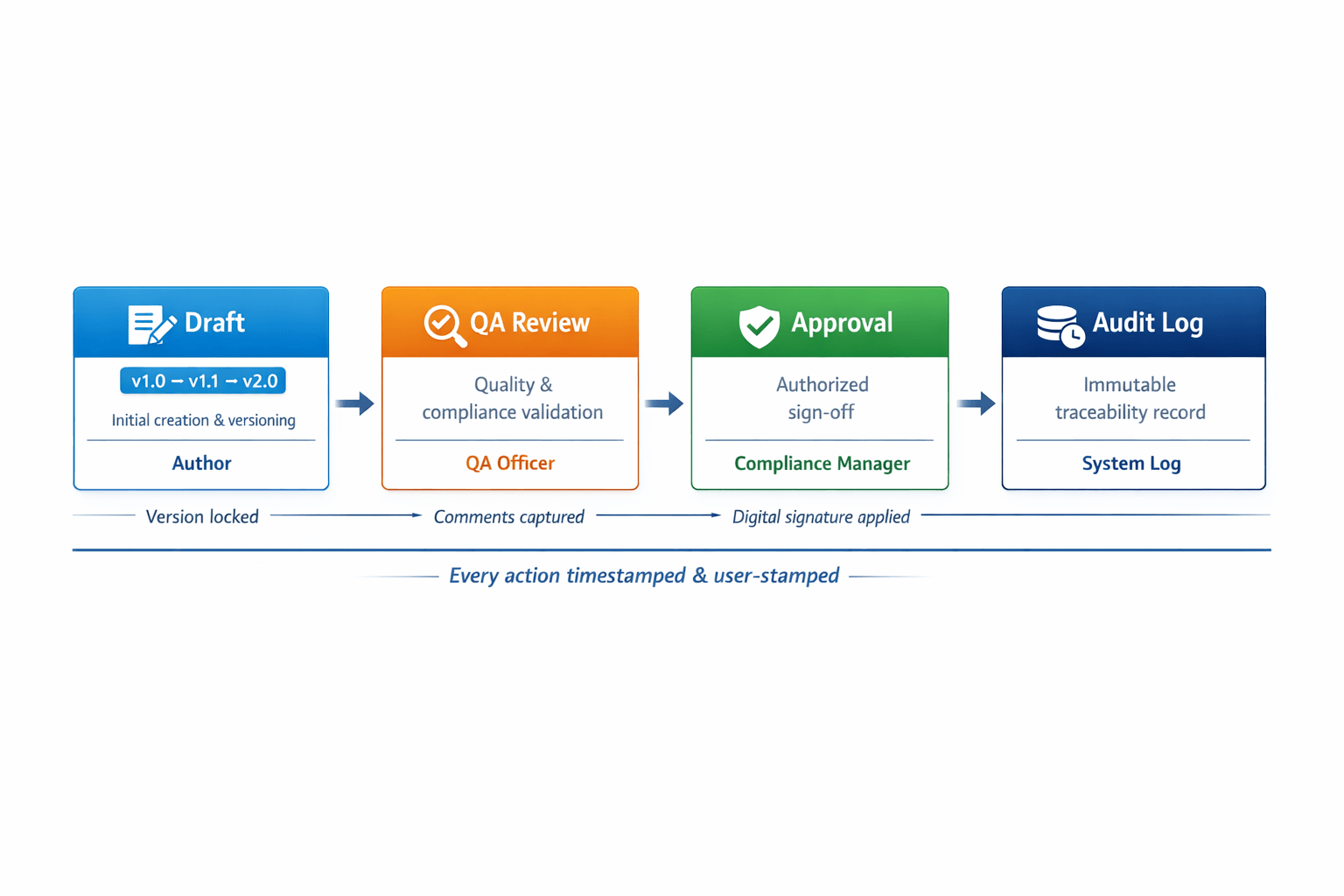
2. Workflow-Linked Approvals
Every document follows a mapped lifecycle:
Draft → QA Review → Supervisor Approval → Release → Audit Log
Each step is:
- Timestamped
- Logged
- Role-controlled
Approvals no longer depend on email trails or paper signatures.
compliance workflow.png
3. Version-Controlled SOPs
Manufacturing floors must always follow the latest approved SOP.
DBOMS ensures
- Only current versions are active
- Older versions remain archived
- Every revision is traceable
This eliminates confusion and reduces shop-floor compliance risk.
4. Real-Time Audit Trails
Every action inside DBOMS is logged automatically:
- Uploads
- Edits
- Reviews
- Approvals
- Comments
When inspectors ask, “Who approved this inspection?”
The answer is immediate — with user identity and timestamp.
5. Compliance Dashboards
Manufacturing leaders can view:
- Audit readiness scores
- Pending document approvals
- Expiry alerts for certifications
- Workflow bottlenecks
Compliance gaps are visible before they become violations.
Visual recommendation: Dashboard mock titled “Audit Readiness: 98%”.
Real-World Manufacturing Scenarios
| Process | Traditional Method | DBOMS Method |
|---|---|---|
| Maintenance logs | Paper sheets & manual signatures | Digitized checklists with auto timestamps |
| Calibration records | Stored in binders | Linked to equipment ID with audit logs |
| Supplier certificates | Email attachments | Centralized, searchable repository |
| Training records | Scattered spreadsheets | Version-controlled employee compliance tracking |
Why Audit-Ready Workflows Matter
Audit-ready systems improve more than compliance.
They strengthen operations by delivering:
- Faster approval cycles
- Reduced human error
- Immediate inspection proof
- Greater regulator and client confidence
In manufacturing, documentation is quality evidence.
When documentation fails, credibility weakens.
From Filing Rooms to Compliance Hubs
DBOMS transforms the manufacturing back office into a digital compliance command center.
Every record has context.
Every approval has proof.
Every audit begins prepared.
In an industry where documentation defines quality, DBOMS defines readiness.